
Flexprice
Usage-based billing platform
Usage-based billing for AI products, open-source or fully managed
Reviewed by The Desk · Last verified July 2026
“A developer-first, open-source billing engine purpose-built for AI and usage-based pricing, with a flat event-volume fee that undercuts percentage-of-revenue rivals. It is promising and transparent, but young and thin on the long production track record that Orb, Metronome, and Stripe Billing can point to.”
Skip it ifYou want a battle-tested, fully managed billing provider with years of enterprise reliability behind it, or your pricing is simple flat-rate subscriptions that Stripe Billing already handles — Flexprice's edge only matters once you have real usage-metering complexity.
What it is
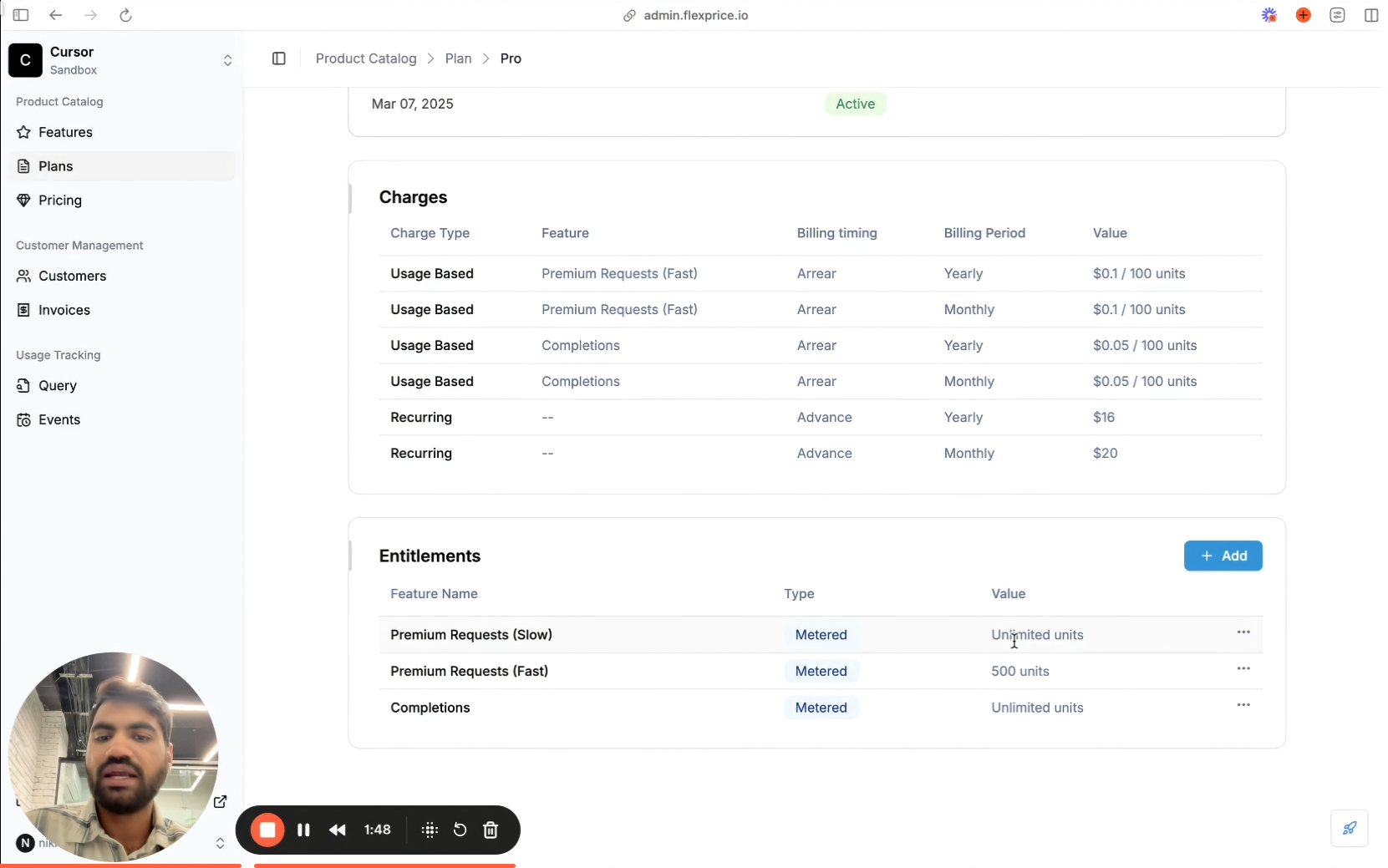
Flexprice is a billing and monetization platform aimed at AI-native and SaaS companies that need to charge customers by actual usage rather than flat subscriptions. It meters events like API calls, token counts, GPU hours, and compute minutes in real time, then turns that raw usage into billable line items, credits, and invoices. The stated goal is to let teams run usage-based, credit-based, seat-based, or hybrid pricing without building and maintaining billing infrastructure themselves.
The product is developer-first and open-core. The core engine is open source under AGPLv3 (written mostly in Go, backed by Postgres, Kafka, ClickHouse, and Temporal) and can be self-hosted via Docker, with SDKs in Go, Python, and JavaScript. Alternatively, a managed cloud runs the same platform with a no-code pricing UI, feature entitlements, prepaid credits and top-ups, automated invoicing, and integrations with Stripe, Paddle, Razorpay, and finance tools. Deployment options extend to on-prem and VPC for teams with data-sovereignty requirements.
Flexprice was founded in 2024 and is based in Gurugram, India, and has raised a seed round (roughly $1.5-2M, led by Shastra VC). It positions itself as an open, flat-fee alternative to Stripe Billing, Orb, and Metronome — notably charging by event volume instead of taking a percentage of revenue. The trade-off is maturity: it is a young company with a small team and a shorter production track record than the incumbents it competes against, so it appeals most to teams that value transparency, control, and cost predictability over a long reliability history.
Key features
- Real-time usage metering (millions of events, sub-60ms P99)
- No-code UI for building pricing plans
- Usage, seat, tiered, credit, and hybrid pricing models
- Prepaid credits, top-ups, expirations, and overage rules
- Automated invoicing with proration and preview
- Feature entitlements and usage-limit enforcement
- Cloud, on-prem, and open-source self-hosted deployment
- SDKs in Go, Python, and JavaScript
Who it’s for
Bill AI products by tokens, API calls, or GPU hours consumed
Run usage-based, credit-based, seat-based, or hybrid pricing without custom code
Manage prepaid credits, top-ups, expirations, and overage rules
Self-host billing to avoid vendor lock-in and revenue-percentage fees
Pros & cons
The good
- Open-source (AGPLv3) and self-hostable, so billing logic stays in your control with no black-box vendor lock-in
- Flat monthly fee tied to event volume rather than a percentage of revenue, which gets cheaper than rivals as you scale
- Built specifically for AI/usage metering (tokens, API calls, GPU hours) with real-time credits, top-ups, and entitlements
The catch
- Founded in 2024 by a small team, with a limited production track record versus Orb, Metronome, or Stripe Billing
- Self-hosting means operating a real stack (Postgres, Kafka, ClickHouse, Temporal) — billing infra is inherently complex to run
- Managed cloud jumps from a free tier straight to $500/month, a steep step for early teams that outgrow the free limits
Pricing
| Tier | Price | What you get |
|---|---|---|
| Free | Free | 100k events/month · Up to $100K cumulative billing revenue · Multiple pricing models · HTTP usage ingestion · PDF invoices, coupons, tax · Community Slack support |
| Build | $500/mo | 1M events/month · Up to $250K cumulative / $20K monthly revenue · 99.9% SLA · Stripe payments integration · Prepaid credits · API key management |
| Scale | $1000/mo | 5M events/month · Up to $1.2M cumulative / $100K monthly revenue · Customer portal · Pricing experiments · Multi-currency, SSO, audit logs · 50+ integrations, whiteglove setup |
| Custom | Custom | Custom event volume · Forward-deployed engineer · 24/7 15-min P0 response · On-prem/VPC deployment · SAML SSO · SOC 2 Type 2 |
Free tier — 100k events/month and up to $100K cumulative billing revenue on cloud; unlimited via open-source self-hosting
Alternatives to Flexprice
More Business Ops →



Questions people ask
Is Flexprice open source and can I self-host it?
Yes. The core platform is open source under AGPLv3 and can be self-hosted on your own infrastructure via Docker Compose. A small set of enterprise features sits behind a commercial license, and a managed cloud version is also available.
How is Flexprice priced compared to other billing tools?
Flexprice charges a flat monthly fee based on event volume rather than a percentage of your revenue. Cloud plans are Free (100k events/month), Build at $500/month (1M events), and Scale at $1,000/month (5M events), with custom enterprise pricing above that.
Who is Flexprice built for?
It targets AI-native and API-first companies that bill by usage — tokens consumed, API calls, GPU hours, or compute minutes — plus SaaS teams running credit-based or hybrid pricing. Engineering, product, and finance teams all get dedicated surfaces.
What does Flexprice integrate with?
It offers native integrations with payment and revenue tools including Stripe, Razorpay, and Paddle, plus HubSpot, QuickBooks, Zoho, Snowflake, and Whop, with additional connections via webhooks and API.