
Lynx
Cross-platform UI framework
Build native iOS, Android, and web apps from one React codebase
Reviewed by The Desk · Last verified July 2026
“A credible React Native/Flutter challenger, battle-tested inside TikTok and genuinely fast thanks to its dual-thread engine and PrimJS runtime. It is worth a serious look for greenfield mobile-plus-web projects where performance matters, provided you can tolerate the rough edges of a young ecosystem.”
Skip it ifYou need a mature, richly documented ecosystem with lots of ready-made plugins today, or you target desktop and other surfaces beyond iOS, Android, and web. Also note it is a general UI framework with no built-in AI features despite its listing here.
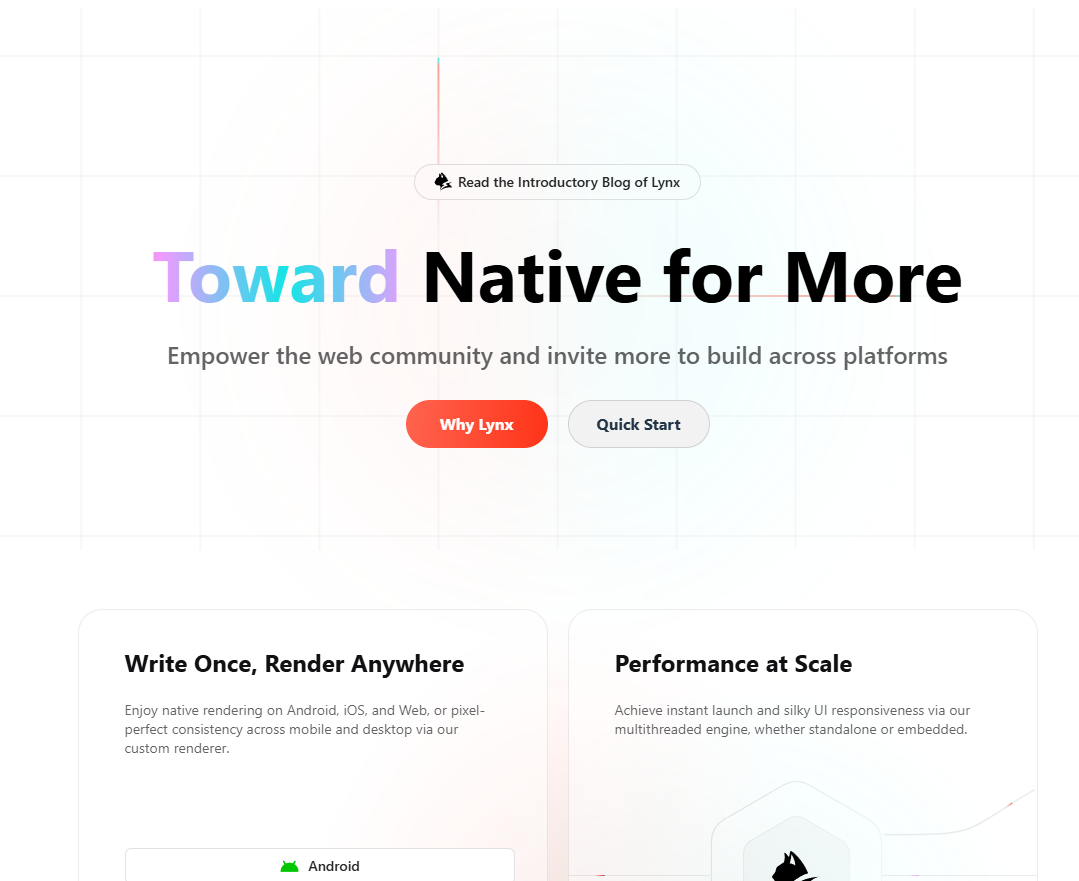
What it is
Lynx is an open-source cross-platform UI framework from ByteDance, open-sourced in March 2025 after years of internal use in products such as TikTok. It lets developers build native applications for iOS, Android, and the web from a single codebase written in React and CSS, positioning itself as a direct alternative to React Native and Flutter.
Technically, Lynx leans on a dual-thread architecture that separates UI rendering from application logic to keep interfaces responsive under load, a custom JavaScript engine called PrimJS optimized for fast startup, and a Rust-based toolchain (Rspeedy) for building. Its React layer, ReactLynx, is built on Preact and supports modern React features like Hooks and Context, while its styling model embraces web-standard CSS including Flexbox, Grid, and animations. The framework is designed for content- and animation-heavy screens, an area where ByteDance has stressed it at scale.
Where it fits: Lynx is a strong candidate for teams with web and React skills who want native performance across mobile and web without maintaining separate stacks. The trade-off is maturity. As a 2025 open-source release, its ecosystem, plugin availability, and documentation are still catching up to more established frameworks, and its roadmap is closely tied to ByteDance. It is a compelling choice for greenfield projects and performance-sensitive UIs, less so for teams that need a deep, proven library ecosystem today.
Key features
- Write once in React and TypeScript and ship to iOS, Android, and web
- Dual-thread engine that splits UI rendering from application logic to reduce stutter
- Real CSS styling including Flexbox, Grid, animations, and transitions
- PrimJS JavaScript engine tuned for fast startup and efficient garbage collection
- Rspeedy Rust-based build tooling plus the Lynx DevTool debugger
- ReactLynx (Preact-based) with Hooks, Context, and modern React APIs
- Instant-first-frame rendering for content-heavy screens
Who it’s for
Build high-performance iOS and Android apps from a single React codebase
Share UI code between native mobile and the web
Let web-focused teams ship native apps without learning Swift or Kotlin
Render animation- and content-heavy screens (feeds, media) without jank
Pros & cons
The good
- Battle-tested at TikTok scale, so it handles complex, animation-heavy UIs
- Fully open source under Apache 2.0 with zero licensing cost
- Familiar to React and CSS developers, with a dual-thread architecture that keeps the UI smooth
The catch
- Very young project (open-sourced in 2025) with a small ecosystem and thin third-party library support
- Documentation, tooling, and learning resources are still maturing versus React Native or Flutter
- Direction and governance are tied to ByteDance, which carries adoption and geopolitical risk for some teams
Pricing
| Tier | Price | What you get |
|---|---|---|
| Open Source (Apache 2.0) | Free | Full framework, build tools, and debugger · iOS, Android, and web targets · No usage limits or licensing fees · Community support via GitHub and Discord |
Alternatives to Lynx
More Coding & Dev →



Questions people ask
Is Lynx free to use?
Yes. Lynx and its core tooling (Rspeedy build tool, Lynx DevTool, and Lynx for Web) are released under the Apache 2.0 license, so it is free and open source with no usage fees.
Who builds Lynx?
Lynx was created by ByteDance, the parent company of TikTok, and open-sourced in March 2025. It was used internally across products like TikTok Studio and Shop before its public release.
How is Lynx different from React Native?
Lynx uses a dual-thread architecture (a dedicated UI thread plus a background logic thread), its own PrimJS JavaScript engine, and true CSS styling with Flexbox and Grid. It targets web as a first-class output in addition to iOS and Android.
Does Lynx include any AI features?
No. Despite appearing in an AI-tools directory, Lynx is a general-purpose cross-platform UI framework with no built-in AI or code-generation capabilities.